
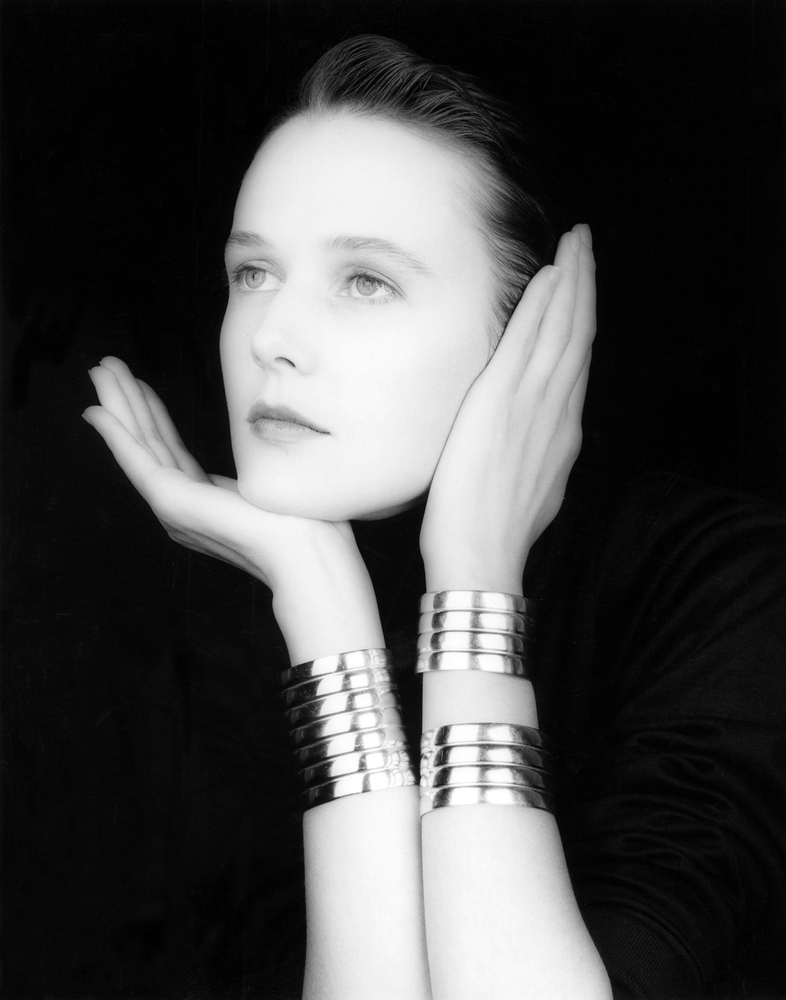
Close-ups: Robert Mapplethorpe by Martin Filler
The contrast between Robert Mapplethorpe's forceful photographs and his gentle personal manner is as extreme and clear-cut as the fathomless blacks and dazzling whites in his impeccably composed pictures. During his highly publicized fifteen-year career, Mapplethorpe has created a body of work as exquisite in technique as it is controversial in content. Much of his art conforms to the classic themes of modern photography, especially portraiture and still lifes. His show last year at New York's Robert Miller Gallery of platinum images printed directly onto canvas andjuxtaposed against panels of luxurious fabrics has been hailed as a breakthrough in extending the boundaries of the photographic medium.
But then there is his other-notorioussubject matter: graphic, often pornographic, depictions of male homoeroticism and fetishism, among the frankest and most startling ever to be displayed in a fine-art context. Yet the two sides of Mapplethorpe's output are united by the same pure perfectionism, relentless formal control, and scrupulous execution that invest even his most scarifying tableaux with an undeniable beauty. (No fewer than four museum retrospectives of his photographs are being held in 1988: at the Stedelijk Museum in Amsterdam, the National Portrait Gallery in London, the Whitney Museum in New York, and the lnstitute of Contemporary Art in Philadelphia.)
The contents of Mapplethorpe's loft in New York have much to do, in form and meaning, with his photographic subject matter. He sees that as entirely natural: "The whole point is to try to integrate your life into your work if you're an artist." Mapplethorpe possesses one, or rather several, of the most remarkable collections of art and decorative objects since death alone put an end to the compulsive acquisitiveness of his friend Andy Warhol. But the big difference between Warhol and Mapplethorpe-aside from the painter's secretiveness and the photographer's confessional candor-is that Mapplethorpe is as attentive to the selective quality and optimum presentation of his possessions as Warhol was indifferent. As Mapplethorpe explains, "l'm doing my best not to do what Andy did. For every great thing, he had ten pieces ofjunk. I just don't have room in my life for all that." He once told a reporter, ''Collecting is an addiction, a crutch to put you in a good mood. . . . Putting together pretty things is another rush I get. "
Everywhere in the Mapplethorpe loft are vignettes of extraordinary visual sophistication. They are invariably instructive, yet it is an experience devoid ofthe dreary hectoring of collections arranged to make a specific and obvious point. Mapplethorpe's rooms revel in the pleasures of art for art's sake and reconfirm his aesthetic genealogy in a direct line of descent from Oscar Wilde and Aubrey Beardsley through Christian B6rard and Jean Cocteau.
Mapplethorpe's mid-Manhattan base serves as both home and studio. (He owns another loft, farther downtown, for his darkroom and office.) Remodeled for its previous owner by architect John McMahon and further refined for Mapplethorpe by architect Robin Prince Zahn, the neutral, cleanly detailed space is an excellent backdrop for the owner's manifold manias. Shelves and tabletops are crammed with 1950s ltalian glass and Scandinavian ceramics. Whole ranges of a workshop's output are massed together, but they are saved from looking like a stockroom by Mapplethorpe's acute eye for placement. The crowded back sitting room, with its tie-back taffeta curtains by decorator Suzy Frankfurt, seems like an affectionate spoof of a "serious" collector's cabinet.
There is an enorrnous range of periods and styles: austere Arts and Crafts furniture by Gustav Stickley next to flamboyant fifties pieces by Gio Ponti and George Nelson; small masterworks by Edouard Vuillard and James Ensor near erotic fantasy illustrations by Tom of Finland; an ebony African Fang tribal sculpture on a blond Biedermeier bracket shelf in front of a matching pedimented mirror. "The real challenge," says Mapplethorpe, "is to take many periods and come up with an aesthetic that runs through them all. If you can mix Biedermeier and Mission and African and fifties, it's more of a challenge than an apartmenthat's all fifties, and it's ultimately more interesting. "
Dispersed throughout are a host of religious and occult objects: crucifixes, pentagrams, skulls, snakes, masks, chalices, and candles dripping wax. Mapplethorpe has called his early photographic assemblages "altarpieces from some bizarre religion," and his loft seems very much like its holy of holies. The striking, often mordant, combinations of the sacred and the profane, the rare and the meretricious, the sublime and the savage are very much like those contrived by another modern-day aesthete, Lincoln Kirstein. In Quarry: A Collection in Lieu of Memoirs, his recent book describing his house, Kirstein writes that "any assemblage of art or craft can be taken as a frame for a minor of its assembler. " That is true to a certain extent of all rooms we create for ourselves, but those of Robert Mapplethorpe encapsulate the intensity of his vision as indelibly as his photographs.